
Professional Microneedling vs At-Home Dermarolling


Table of Contents
- Professional Microneedling vs At-Home Dermarolling: Key Differences
- Safety and Sterility: Professional vs Home Treatment
- Microneedling Recovery Time and Downtime
- At-Home Dermarolling Risks You Should Know
- Results: Collagen Induction and Skin Rejuvenation
- Microneedling Aftercare: Post-Procedure Protocols
- How Often to Use a Dermaroller at Home
- Cost Comparison: DIY vs Professional Treatment
- Frequently Asked Questions
Last Updated: October 6, 2026
Professional Microneedling vs At-Home Dermarolling: Key Differences
Professional microneedling and at-home dermarolling sound similar on the surface, but the differences run deep, literally. The depth of needle penetration, the precision of application, and the clinical protocols that surround each treatment create vastly different outcomes. Understanding these distinctions matters because choosing the wrong approach can mean wasting money on a device that won’t deliver results, or worse, damaging your skin barrier.
Device Specifications and Needle Depth
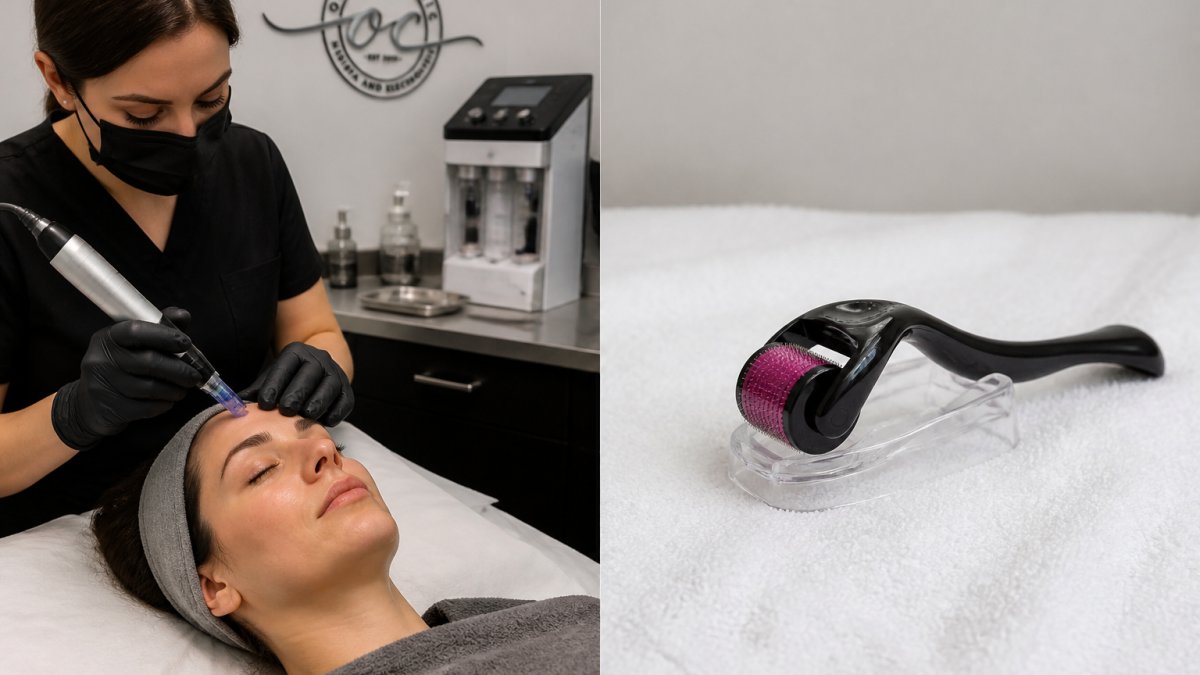
Professional microneedling uses medical-grade devices with needle depths ranging from 0.5mm to 3.0mm, depending on the treatment goal and skin condition.
At-home dermarollers, by contrast, operate at much shallower depths: typically 0.2mm to 0.5mm.
The difference matters because collagen induction, the mechanism that actually improves skin texture and reduces fine lines, requires reaching the dermal layer.
Treatment Protocol and Technique
Professional microneedling follows a structured clinical protocol. The skin is cleansed, a topical anesthetic is applied, and the treatment is performed with a motorized or pneumatic device that controls speed, pressure, and depth.
At-home dermarolling relies entirely on user technique. You cleanse your skin, roll the device across your face in vertical, horizontal, and diagonal directions, and hope the pressure is consistent.
The protocol difference extends to frequency and recovery. Professional treatments are spaced 4-6 weeks apart to allow the skin’s healing cycle to complete.
Safety and Sterility: Professional vs Home Treatment
Sterile environment and cross-contamination risk are where the safety gap becomes critical. Professional microneedling is performed in a controlled, sterile setting.
At-home dermarolling presents real infection risks. Most home-use devices are reusable, which means proper sanitation is essential, and most people don’t do it correctly. A dermaroller stored in a bathroom drawer, rinsed with tap water, and left to air-dry is a vector for bacterial growth.
How to Sanitize an At-Home Dermaroller Properly
If you use an at-home device, follow this sequence every single time, before and after use:
- Wash hands thoroughly with soap and water.
- Rinse the roller head under warm running water to remove visible debris.
- Submerge the roller head in 70% isopropyl alcohol for at least 10 minutes. Do not dilute it.
- Remove and allow to air-dry completely on a clean, lint-free surface. Do not towel-dry, which reintroduces bacteria and can bend needles.
- Store the device in its original case or a sealed, clean container. Never store it uncovered in a bathroom.
- Replace the roller after 8 to 12 uses, or immediately if needles appear dull, bent, or discolored.
Boiling does not reliably sterilize a dermaroller and can warp the plastic housing, misaligning the needles. Alcohol soaking is the minimum standard for home use, not the equivalent of autoclave sterilization.
Contraindications: Who Should Never Use an At-Home Dermaroller
This is the screening step most at-home users skip entirely. Do not use an at-home dermaroller if any of the following apply:
- Active acne lesions or open breakouts in the treatment area
- Rosacea or a history of facial flushing and broken capillaries
- Eczema, psoriasis, or any active dermatitis in the treatment area
- Melasma or a strong tendency to post-inflammatory hyperpigmentation
- Active cold sore or any viral skin infection
- Use of isotretinoin within the past 6 months
- Use of prescription retinoids, unless cleared by a physician
- Blood-thinning medication or a bleeding disorder
- Diabetes, immunosuppression, or any condition that slows wound healing
- A history of keloid or hypertrophic scarring
- Pregnancy, unless cleared by a physician
A professional practitioner screens for all of these before treatment and adjusts depth, technique, or declines treatment when the risk is too high. At home, there is no screening step, which is exactly how preventable complications happen.
Cross-Contamination and Infection Risk
When you create hundreds of micro-channels in your skin, you’re temporarily disrupting the epidermal barrier. In a professional setting, this controlled disruption happens in a sterile environment, and the skin is immediately protected with medical-grade serums and post-procedure guidance.
The risk isn’t theoretical. Dermaroller-induced infections, ranging from mild bacterial folliculitis to more serious staph infections, are documented. Most cases result from improper device sanitation or overuse that damages the skin barrier beyond the point of quick recovery.
Skin Trauma and Adverse Reactions
Professional practitioners are trained to recognize skin type, sensitivity, and contraindications. They know when to avoid certain areas and when to adjust depth based on skin response. They understand that clients on certain medications need modified protocols.
At-home users lack this clinical judgment. Someone with sensitive skin might use the same pressure and frequency as someone with resilient skin, leading to excessive erythema, post-inflammatory hyperpigmentation, or worse, scarring from overly aggressive rolling. The at-home setting also means no professional monitoring for adverse reactions during or immediately after treatment.
Microneedling Recovery Time and Downtime
Professional microneedling at deeper depths (1.5mm to 2.5mm) typically causes visible redness and minor swelling for 24-48 hours. This is expected and part of the healing response. Most people can return to normal activities the next day, though sun exposure should be avoided for several days.
At-home dermarolling at shallower depths causes minimal downtime, often just slight redness that fades within hours. This seems like an advantage until you realize it’s because the device isn’t penetrating deeply enough to trigger meaningful collagen induction.
At-Home Dermarolling Risks You Should Know
The risks of at-home dermarolling extend beyond infection. Overuse is common because people don’t see results and assume more rolling will help.
Needle quality varies wildly among at-home devices. Cheaper dermarollers have blunt or uneven needles that tear skin rather than create clean channels. This causes more inflammation, slower healing, and higher scarring risk.
Another overlooked risk: at-home dermarolling can trigger or worsen certain skin conditions. If you have rosacea, active acne, or melasma, aggressive microneedling can increase inflammation and post-inflammatory hyperpigmentation.
Results: Collagen Induction and Skin Rejuvenation
The results gap between professional and at-home treatment is significant. Professional microneedling at therapeutic depths (1.5mm to 2.5mm) triggers strong collagen and elastin synthesis over 8-12 weeks. Clients typically see visible improvement in fine lines, skin texture, pore size reduction, and overall skin firmness after 3-4 sessions spaced 4-6 weeks apart.
Professional Treatment Outcomes
Professional microneedling delivers measurable skin rejuvenation because it reaches the dermal layer where fibroblasts live. These cells respond to the controlled injury by producing new collagen and elastin. The result is thicker, more resilient skin with improved texture and reduced appearance of fine lines and wrinkles.
For acne scarring, professional microneedling is one of the few treatments that actually improves the scar itself by encouraging collagen remodeling in the scarred tissue. At-home dermarolling cannot achieve this because it doesn’t penetrate deeply enough to reach the scar tissue.
At-Home Device Limitations
At-home dermarollers improve surface texture through exfoliation and can slightly increase topical serum absorption. But they don’t consistently trigger collagen induction at depths that lead to lasting skin rejuvenation.
The limitation isn’t a flaw in the concept, it’s a limitation of the device itself. A 0.3mm dermaroller simply cannot reach the fibroblasts. It’s like expecting a superficial peel to deliver the results of a deep chemical peel. Both have value, but they’re not equivalent.
Microneedling Aftercare: Post-Procedure Protocols
Professional aftercare is where much of the treatment’s benefit is realized. Immediately after professional microneedling, the skin is treated with medical-grade serums, typically hyaluronic acid, peptides, or growth factors, while the skin barrier is temporarily compromised. This transdermal absorption is far more efficient than applying the same serum to intact skin.
Professional Aftercare Guidance
A professional clinic provides detailed post-procedure protocols: what products to use, what to avoid, how long to wait before resuming certain activities, and when sun exposure is safe. Clients receive guidance on maintaining skin barrier integrity while supporting the collagen-building process.
Professional aftercare also includes follow-up assessments. If a client develops unexpected inflammation or sensitivity, the clinic can intervene quickly. At home, you’re on your own.
Home Care Between Sessions
Between professional treatments, proper home care amplifies results. This means using the right serums (hyaluronic acid, niacinamide, peptides), avoiding active ingredients that might compromise barrier integrity, and strict sun protection. Many clients benefit from medical-grade skincare formulas developed specifically to support collagen production and skin barrier health.
At-home dermaroller users need similar discipline, but the baseline treatment is weaker, so the supporting care has less to build on.
How Often to Use a Dermaroller at Home
If you’re using an at-home dermaroller, frequency matters, and most people get it wrong. A 0.3mm dermaroller can be used 1-2 times per week without damaging the skin barrier.
A 0.5mm dermaroller should be used no more than once every 2 weeks. Beyond this frequency, you’re creating more damage than the skin can repair between sessions.
Professional microneedling, by contrast, is performed every 4-6 weeks because deeper penetration requires longer recovery. The skin needs time to complete its healing cycle and build new collagen before the next treatment.
Cost Comparison: DIY vs Professional Treatment
At-home dermarollers are inexpensive to buy but expensive to use correctly. A 0.3mm roller typically costs $20 to $60, and a 0.5mm roller $40 to $120, depending on needle material and sterilization claims.
Pricing for professional microneedling depends on the specific treatment plan, number of sessions, and areas treated. For current prices or a personalized quote, please book a free consultation.
| Factor | At-Home Dermaroller | Professional Microneedling |
|---|---|---|
| Upfront cost | $20 to $120 | $300 to $800 per session |
| Replacement / repeat cost | Every 8 to 12 uses | Per session, 3 to 4 to start |
| Typical first-year total | $60 to $250 | $1,200 to $3,200 |
| Depth reached | 0.2mm to 0.5mm | 0.5mm to 3.0mm |
| Collagen induction | Minimal to none | Reliable at therapeutic depths |
| Results duration | Fades when use stops | 6 to 12 months with maintenance |
Cost-per-result is where the comparison shifts. If a $60 roller delivers only temporary surface smoothing, the cost per meaningful outcome is high because the outcome never arrives.
The cheapest device is not the cheapest path to results. Compare cost per outcome, not cost per purchase.
There is also a hidden cost to at-home overuse: barrier damage, post-inflammatory hyperpigmentation, and in some cases scarring that then requires professional correction. Treating a complication can cost more than the professional treatment would have in the first place.
Frequently Asked Questions
Is professional microneedling safer than at-home dermarolling?
Professional microneedling is generally safer due to sterile equipment, controlled needle depth, and expert technique. At-home dermarolling carries higher risks of cross-contamination, uneven penetration, and skin trauma if the device is not properly maintained or used correctly. Professional treatments use medical-grade devices in a sterile environment, reducing infection risk and post-inflammatory hyperpigmentation. At-home tools, even high-quality ones, cannot match the safety protocols of a clinical setting.
What is the difference between microneedling and dermarolling?
Microneedling uses motorized devices with precise needle depths (typically 0.5-2.5 millimetres) to create controlled skin trauma and stimulate collagen induction therapy. Dermarolling relies on manual rolling with shorter needles (usually 0.2-0.3 millimetres) and less consistent penetration. Professional microneedling achieves deeper dermal penetration, more uniform results, and stronger fibroblast stimulation. At-home dermarollers primarily provide surface exfoliation and modest topical serum absorption, with limited collagen production benefits.
Can at-home dermarolling produce the same results as professional microneedling?
At-home dermarolling cannot match professional microneedling results. Professional treatment penetrates deeper into the dermis, triggering more significant collagen and elastin synthesis. At-home devices work mainly on the epidermis and upper dermis, producing modest skin texture improvement and fine line reduction. For acne scarring, pore size reduction, and dramatic skin rejuvenation, professional microneedling delivers superior clinical efficacy. At-home tools are better suited for maintenance and mild skin concerns.
How often should you use a dermaroller at home?
Most at-home dermarollers with 0.2-0.3 millimetre needles can be used once or twice weekly. Longer-needle devices (0.5 millimetres or more) should be used less frequently, typically every 2-4 weeks. Overuse causes excessive erythema, skin barrier damage, and increased infection risk. Professional microneedling sessions are spaced 4-6 weeks apart due to deeper penetration and stronger inflammatory response. Always allow full skin recovery between sessions and follow manufacturer guidance for your specific device.
What should you avoid after microneedling?
After professional microneedling, avoid direct sunlight, strenuous exercise, and swimming for 24-48 hours. Do not use harsh skincare products, acids, or retinoids for 5-7 days. Avoid touching the treated area and do not apply heavy makeup immediately. Skip hot water and saunas, which increase erythema and inflammation. Use only gentle, fragrance-free cleansers and apply recommended serums to support skin barrier integrity and topical serum absorption. Your clinician will provide detailed aftercare instructions specific to your treatment depth.
