
How to Test European Skincare for Sensitive Skin


Last Updated: October 28, 2026
Quick Summary
The benefits of european skincare for sensitive skin usually come from fragrance-free or lightly scented formulas, simple ingredient lists, and a focus on hydration and barrier comfort. These traits reduce common sources of stinging, but they are tendencies rather than guarantees, so every product still needs a patch test.
- Check the first five ingredients for fragrance, essential oils, and alcohol denat.
- Patch test a new product on a small area for about a week before full use.
- Introduce one new product per week so any reaction can be traced to its cause.
- Keep a short personal trigger list and check every new product against it.
- European cosmetic rules guarantee safety and labeling, not gentleness for sensitive skin.
Table of Contents
- Why European Skincare Often Suits Sensitive Skin
- How to Read European Skincare Ingredients for Sensitive Skin
- How to Patch Test Skincare Products Before Full Use
- Building a Sensitive Skin Skincare Routine, Step by Step
- Common Mistakes When Introducing New Products
- When to Book a Professional Skin Consultation
- Frequently Asked Questions
Why European Skincare Often Suits Sensitive Skin
Sensitive skin reacts easily to heat, friction, fragrance, and harsh ingredients. Many people with this skin type look for gentle formulas that calm redness and support the skin barrier. European skincare has a long reputation for this kind of gentle, hydrating approach, and it is one reason so many people with reactive skin look to it first.
The benefits of European skincare for sensitive skin come from a few common traits: fragrance-free or lightly scented formulas, simple ingredient lists, and a focus on hydration and barrier comfort.
Here is what those traits usually look like in practice:
- Lower fragrance content, which reduces a common source of stinging
- Fewer ingredients per product, which makes reactions easier to trace
- Botanical oils and mineral-based ingredients used for soothing and moisture
- Formulas built around protecting the skin barrier rather than stripping it
These are general tendencies, not guarantees. Two products from the same region can behave very differently on the same face. That is why the rest of this guide focuses on how to test and choose, not just what to buy.
How to Read European Skincare Ingredients for Sensitive Skin
Ingredient labels look intimidating, but you only need to scan a few things. European formulas are required to list ingredients by INCI name in descending order of concentration down to 1%, and anything present at 1% or less can be listed in any order after that point. That single rule tells you most of what you need: if “parfum” or a botanical oil appears in the first five ingredients, it is a meaningful part of the formula, not a trace.
Start with the first five ingredients, since they make up the bulk of the product, then scan the rest for known irritants.
Common ingredients that sensitive skin often tolerates well include:
- Glycerin, a humectant that draws water into the upper skin layers
- Squalane, a light emollient that supports the barrier without heaviness
- Panthenol, a form of vitamin B5 used to soothe and reduce visible tightness
- Ceramides (often listed as ceramide NP, AP, or EOP), lipids that help the skin hold water
- Niacinamide, tolerated by many at 2-5% but a trigger for some above that range
- Bisabolol and allantoin, common soothing agents in European pharmacy lines
Ingredients that more often trigger reactions in sensitive skin include:
- Fragrance (listed as “parfum” or “fragrance”), the single most common cosmetic contact allergen
- Essential oils, lavender, citrus peel, peppermint, eucalyptus, and tea tree are frequent offenders, and they can appear under dozens of botanical names
- Denatured alcohol (alcohol denat.), which can sting compromised skin
- Preservatives such as methylisothiazolinone (MI), which is restricted in leave-on products in many markets for this reason
- Exfoliating acids (glycolic, lactic, salicylic) and retinoids, which are fine for many but need slow introduction
A “natural” or “botanical” label does not mean gentle. Many plant extracts are irritating for reactive skin, and essential oils are among the most common causes of cosmetic contact dermatitis. Judge the full ingredient list, not the marketing words on the front.
A “hypoallergenic” claim is also not a regulated guarantee, it means the maker avoided common allergens, not that the product is allergen-free for you.
What European Standards Do and Do Not Guarantee
European cosmetic regulation is often cited as a reason these products suit sensitive skin, but it helps to know what the rules actually cover. Fragrance allergens above set thresholds must be declared individually on the label (Fragrance allergens labelling).
What the rules do not do is certify a product as gentle, non-irritating, or suitable for sensitive skin. There is no official “sensitive skin” certification. A product can comply fully with European rules and still sting your face. Treat regulation as a floor for safety and labeling transparency, not a promise of tolerance.
How to Assess a Label in Practice
- Check the first five ingredients for fragrance, essential oils, and alcohol denat.
- Scan the full list for your personal known triggers.
- Look for declared fragrance allergens (limonene, linalool, citronellol, geraniol, eugenol), their presence signals added fragrance even when “parfum” is not listed.
- Note the product format, a rich cream with the same actives as a light lotion will behave differently on reactive skin.
- Keep a short personal trigger list and check every new product against it before buying.
When comparing products, keep a short list of the ingredients you already know cause problems for you. Check every new product against that list before buying.
How to Patch Test Skincare Products Before Full Use
A patch test is the simplest way to catch a reaction before it spreads across your face. It takes a few days, but it saves a lot of discomfort. Test every new product, even ones from a trusted line.
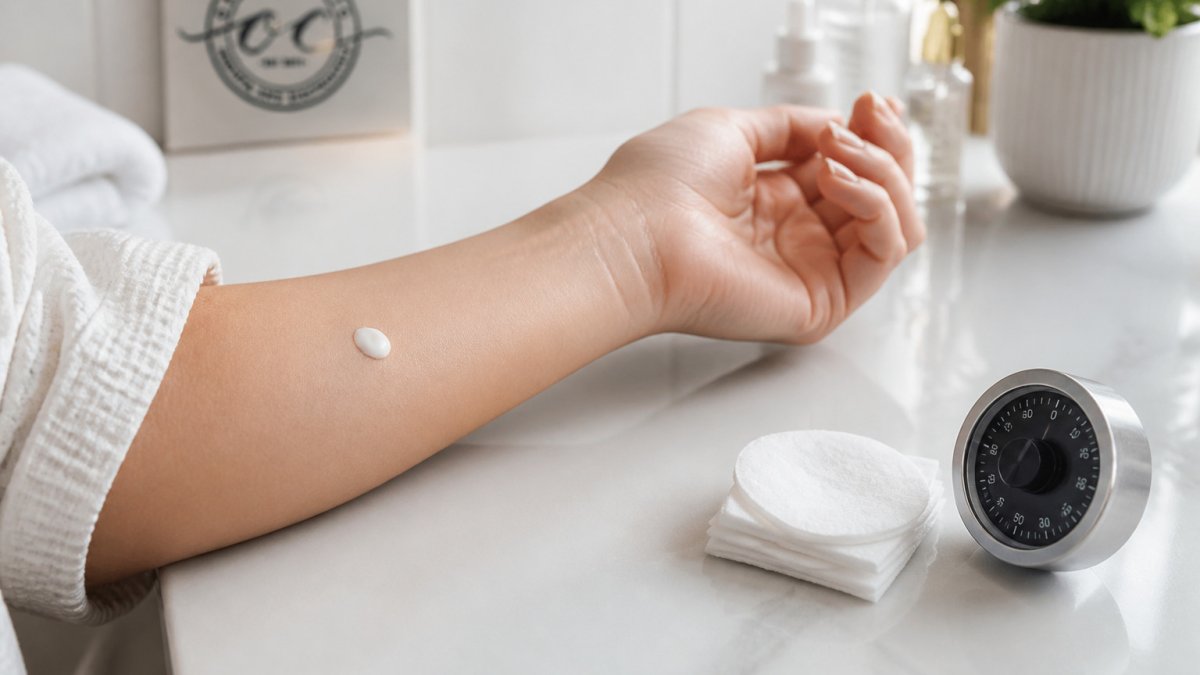
The basic method is to apply a small amount of product to a clean, small area and wait. Most people follow a simple routine:
- Apply a pea-sized amount to the test area once a day
- Wait at least 48 hours before judging the result
- Continue for about a week if the first two days look clear
- Stop and rinse if stinging, burning, itching, or swelling appears
Choosing a Test Area and Timing
Pick a spot that is similar to your face but not highly visible. The inner forearm or the area just behind the ear works well because the skin there is thin and reacts visibly. Avoid broken or freshly treated skin.
Test in the evening, when your skin is calm and you are not wearing other products on the test area. This makes it easier to tell whether the new product is causing a change.
Recognizing Early Signs of Irritation
Early irritation is often subtle. Look for these signs during the test period:
- Redness that lasts longer than a few minutes after application
- Tingling or stinging that does not fade quickly
- Small bumps, dryness, or flaking in the test spot
- Itching that gets worse over the testing days
A little tingling with a strong active can be normal, but persistent stinging is a signal to stop. If you feel unsure, stop the test and try a gentler product.
Building a Sensitive Skin Skincare Routine, Step by Step
Once a product passes its patch test, add it slowly. Introducing several new products at once makes it impossible to know which one caused a reaction.
A simple starting routine for sensitive skin usually looks like this:
- Gentle cleanser in the morning and evening, a cream or lotion cleanser rather than a foaming gel
- Hydrating toner or essence to add water to the skin
- Barrier-supporting moisturizer with ceramides or squalane
- Mineral sunscreen during the day, since sun exposure can aggravate sensitive skin
A Safe Introduction Schedule
Introduce one new product per week. This slow pace gives your skin time to show how it responds. A practical sequence looks like this:
- Week 1: Swap in the gentle cleanser only. Keep everything else the same.
- Week 2: Add the moisturizer. Use it morning and evening.
- Week 3: Add the hydrating toner or essence between cleanse and moisturize.
- Week 4: Add the mineral sunscreen in the morning.
- Week 5+: Reintroduce any strong actives (retinoids, exfoliating acids) at lower strength and frequency, two nights a week, then build up.
If a reaction appears at any step, stop the new product, return to the last known-good routine, and wait until the skin settles before trying again. If you already use strong actives, such as retinoids, bring them back in later and at a lower strength.
Personalizing by Trigger and Skin State
Sensitive skin is not one condition. The routine that suits someone with rosacea-prone redness is not the same as the one that suits someone with eczema or barrier damage from over-exfoliation. Use this decision guide:
- Trigger: fragrance and essential oils. Prioritize fragrance-free formulas and check the full INCI list for declared allergens.
- Trigger: heat and flushing. Keep the routine minimal, favor lightweight lotions over rich creams, and avoid hot water and steam.
- Trigger: cold, wind, and dry indoor air. Switch to a richer moisturizer with ceramides and occlusives, and add a hydrating layer under it.
- Trigger: over-exfoliation or barrier damage. Stop all acids and retinoids, use only cleanser, moisturizer, and sunscreen for two to four weeks, then reintroduce one product at a time.
- Trigger: stress and hormonal flares. Keep a stable baseline routine and avoid adding new products during a flare, you cannot judge a product’s effect on already-irritated skin.
Adapting the Routine by Season
A routine that works in a humid summer can fail in a dry winter. A common pattern is to lighten the moisturizer and add a hydrating layer in warm, humid months, then switch to a richer barrier cream and reduce cleansing frequency in cold, dry months. Indoor heating and air conditioning both lower humidity, so the same skin can need different products in January and July.
Common Mistakes When Introducing New Products
Most reactions come from a few predictable habits. Avoiding them makes the whole process easier.
- Skipping the patch test because a product is from a well-known line
- Adding several products at once, which hides the cause of any reaction
- Using a new product on irritated skin, which often makes the irritation worse
- Judging results too quickly, before the skin has had time to respond
- Layering strong actives together in the same routine
A common mistake is assuming that more product means better results. For sensitive skin, a thin layer of a simple formula usually works better than a heavy routine.
When to Book a Professional Skin Consultation
Home testing handles most mild reactions, but some situations call for a professional opinion. Book a consultation if your skin stays red or swollen for several days, if you develop blisters or rash, or if breakouts and dryness keep returning despite a careful routine.
A professional can look at your skin, review your products, and suggest a plan that fits your skin type.
Frequently Asked Questions
What are the benefits of European skincare for sensitive skin?
European skincare lines often focus on simpler formulas, fewer fragrances and gentle botanical or mineral ingredients, which many people with sensitive skin find easier to tolerate. Benefits people commonly report include better hydration, a calmer look to visible redness and improved skin comfort over time. Results vary by person, so a product that suits one person may not suit another. Introducing each product slowly and reviewing how skin responds is the most reliable way to judge whether it works for your skin.
How long should I test a new skincare product before using it regularly?
Most people patch test a new product on a small area for about 24 to 48 hours before using it on the face. If no redness, stinging, itching or swelling appears in that time, you can start using it, usually every other day at first. Increase frequency gradually over one to two weeks. If irritation develops at any stage, stop using the product and seek advice from a qualified skin professional.
Which European skincare ingredients are suitable for sensitive skin?
Ingredients often chosen for sensitive skin include glycerin, hyaluronic acid, ceramides, panthenol and gentle plant oils, as they support hydration and the skin barrier. Ingredients that more commonly irritate sensitive skin include strong fragrances, high concentrations of alcohol, some essential oils and strong exfoliating acids. Reading the full ingredient list, rather than relying on front-of-pack claims, helps you spot these before you buy.
How can I tell if a European skincare product will irritate my skin?
Watch for stinging or burning on application, itching, tightness, new redness, bumps or flaking in the test area. Mild tingling can be normal with some active ingredients, but persistent discomfort is a sign to stop. A patch test on the inner forearm or behind the ear, repeated over two days, gives a useful early read. If you have a history of reactions, a dermatologist or qualified skin professional can help you identify likely triggers.

